

Two "Inevitable" Victories, One Coming Catastrophe: How Moscow and Kyiv Are Weaponizing the Information War — and Pushing the World Toward Hypersonic Escalation
Russian-Ukrainian Information Operations: "Inevitability" Narratives and Escalation Risk

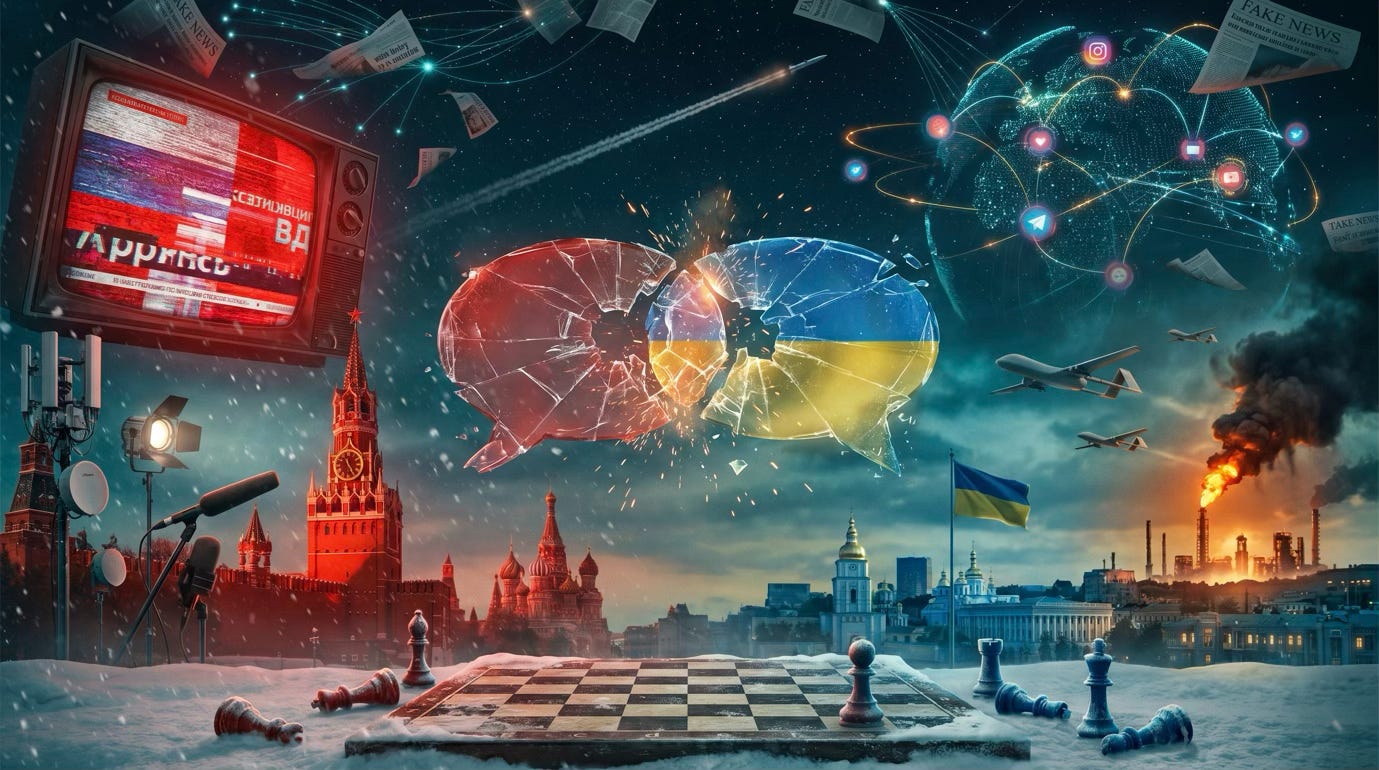
Two “Inevitable” Victories, One Coming Catastrophe: How Moscow and Kyiv Are Weaponizing the Information War — and Pushing the World Toward Hypersonic Escalation
Both Russia and Ukraine are now fighting a parallel war for the world’s mind — and it’s escalating faster than the one on the ground. Moscow blasts a triumphalist “inevitable victory” narrative through Putin, Peskov, and Lavrov to crack Western sanctions and arms support, while Kyiv counters with deep-strike “proof points” against Russian refineries like Tuapse to convince allies that Russia is on the brink. The catch: each missile and drone now doubles as a propaganda weapon, creating a strike-narrative ratchet where neither side can afford to leave any blow unanswered.
The off-ramps are closing — and the Oreshnik hypersonic missile is sitting at the edge of the table. Read the full report:
Executive Summary
Bottom Line Up Front
Throughout April 2026, both Russia and Ukraine have intensified competing “inevitability” narratives designed to shape the perceptions of external audiences — allied governments, international media, and the global public — regarding battlefield momentum, political endurance, and the prospective terms of any negotiated settlement. Moscow emphasises daily territorial gains, frames Ukraine as being in a state of ‘agony,’ and signals through senior officials (Peskov, Lavrov) that negotiations will proceed on Russian terms due to purported front-line advances. Kyiv counters by publicising deep-strike successes against Russian energy infrastructure (notably Tuapse refinery), highlighting ISW assessments that Russian advance rates have halved year-on-year, and asserting that Russia’s battlefield position is the weakest in ten months. Both sets of claims selectively present evidence and are designed to influence allied decision-making on sanctions, arms deliveries, and diplomatic timelines. The interaction between long-range strikes and these narratives is escalatory: each side uses kinetic actions as “proof points” for its information campaign, raising the symbolic stakes of individual engagements and narrowing the perceived space for off-ramps. External audiences — especially the United States (distracted by the Iran conflict), European publics, and Gulf states — play a critical role in sustaining these hardened positions. The overall risk trajectory is upward. The convergence of narrative hardening, long-range strike escalation, and attention diversion by the Iran conflict creates conditions where miscalculation or a symbolic provocation could trigger a significant escalation without either side having prepared domestic constituencies for compromise.
Key Risk Findings
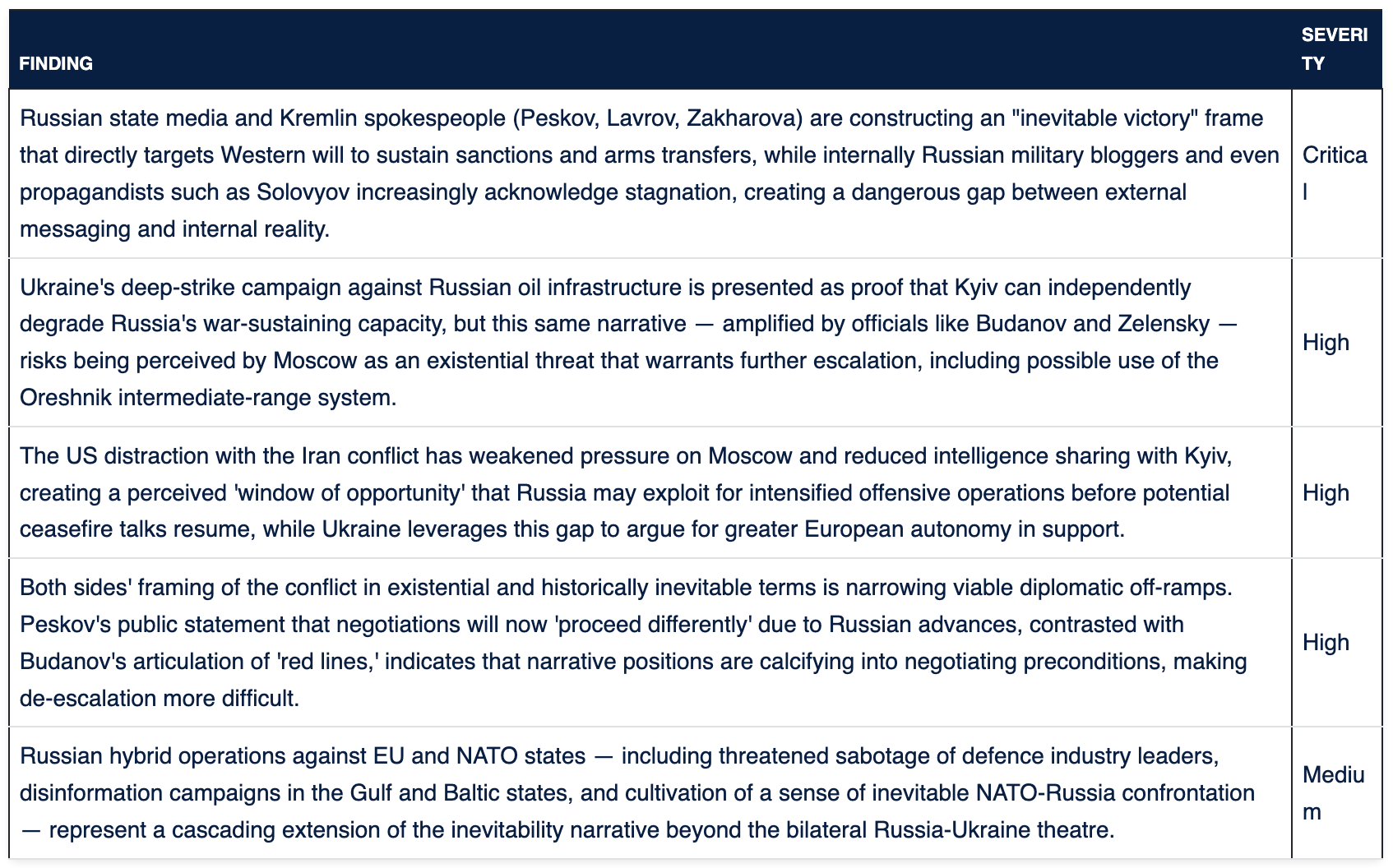
Overall Risk Rating
High
Narratives
Narrative
The April 2026 information environment around the Russia-Ukraine war is dominated by two competing but structurally similar meta-narratives of inevitability. Russia projects the inevitability of Ukrainian collapse and Western abandonment; Ukraine projects the inevitability of Russian exhaustion and strategic overreach. These narratives are not merely rhetorical — they are operationally consequential, shaping allied resource allocation, sanctions enforcement, arms transfer decisions, and the psychological conditions under which either side might accept or reject negotiations. Russia’s narrative apparatus operates on multiple tiers. At the highest level, Putin himself repeatedly claims that Kyiv loses territory daily, despite expert assessments (including from Novaya Gazeta Europe and ISW) that Russian forces lack the capacity to capture major cities. Kremlin spokesperson Peskov explicitly links front-line claims to a negotiating posture, asserting that Russia will conduct talks ‘differently’ because of military progress. Pro-Kremlin political commentators like Yuri Kot describe Ukraine as entering a state of ‘agony.’ At the propagandist tier, however, cracks are visible: Vladimir Solovyov has drawn parallels between Russia’s situation and Napoleon’s, military bloggers acknowledge exhaustion of offensive potential, and even Zakharova has publicly complained about fighting on ‘three fronts.’ This internal contradiction — triumphalism for external audiences, anxiety internally — is a signature vulnerability in Russia’s information architecture. Ukraine’s counter-narrative is anchored in three pillars: (1) battlefield resilience (Zelensky’s claim that Ukrainian positions are the strongest in 9-10 months, Commander-in-Chief Syrskyi’s emphasis on innovation changing the rules of war); (2) strategic strikes on Russian depth (Budanov’s explanation that Russia avoids publicising Ukrainian deep strikes to conceal vulnerability, attacks on Tuapse and other refineries); and (3) reframing Western support needs (Zelensky’s argument that US distraction with Iran weakens pressure on Russia, combined with signals that Ukraine is learning to fight without American support). Each pillar serves a specific audience: European defence planners, global energy markets, and the US administration respectively. The interaction between long-range strikes and these narratives is the most escalation-prone dynamic in the current phase. Ukrainian drone and missile attacks on Russian energy infrastructure serve dual purposes: material degradation of Russia’s war economy and symbolic proof for external audiences that Ukraine retains strategic agency. Russia’s infrastructure strikes on Ukraine serve a mirror function. The danger is that each successful strike raises the symbolic stakes for retaliation, creating a ratchet dynamic where neither side can afford to leave a strike unanswered without undermining its own inevitability narrative. The reported discussion of Oreshnik deployment — a hypersonic intermediate-range system — against Ukrainian targets represents the sharpest edge of this escalation risk. External audiences are not passive consumers of these narratives. The Atlantic Council analysis cited in reporting explicitly warns that ‘myths of Moscow’s inevitable victory have spread even to Trump,’ indicating that Russian disinformation has penetrated Western elite decision-making. Simultaneously, Ukraine uses the Baltic threat narrative to reinforce the argument for sustained Western support, while Russia leverages Gulf-state information operations to weaken Ukrainian diplomatic gains. Both sides are fighting for narrative dominance not just over each other’s populations but over the global information commons. For analysts, distinguishing real battlefield shifts from manufactured inevitability requires attention to several indicators: rate of territorial change relative to casualties (ISW data showing Russian advance rates halved year-on-year is a strong corrective to Kremlin claims); mobilisation sustainability (Kovalenko’s estimate of 80,000 per month needed for continued creeping advance); internal Russian rhetoric shifts (the growing gap between triumphalist external messaging and anxious internal commentary); and the tempo and targeting patterns of deep strikes by both sides. When narrative hardening is accompanied by acceleration in these material indicators, it may signal genuine strategic change; when narrative hardening occurs against a backdrop of stagnant or deteriorating material conditions, it is more likely an information operation. Realistic diplomatic mechanisms for de-escalation remain limited but not zero. Confidence-building steps could include energy infrastructure strike restraint agreements (tacit or explicit), prisoner exchanges, and grain corridor maintenance. However, each side currently frames any restraint as potential capitulation. The most promising avenue may be third-party-mediated ‘quiet diplomacy’ that avoids the public inevitability framing altogether, allowing each side to manage domestic expectations separately from negotiating positions.
Key Narrative Findings
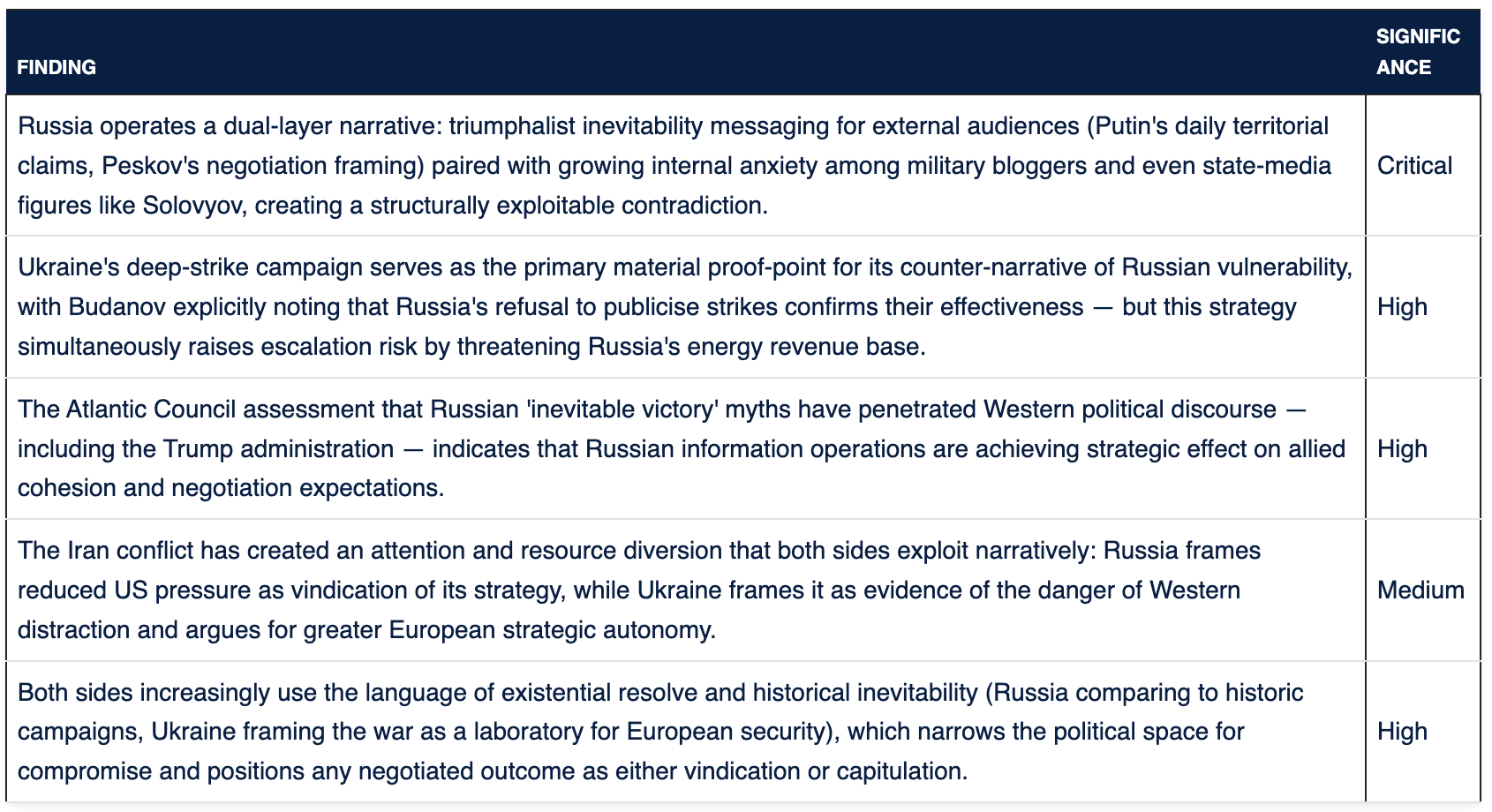
Overall Narrative Rating
High
Background and Context
Assessment Scope
This assessment covers the information operations environment of the Russia-Ukraine war during April 2026, with specific focus on competing ‘inevitability’ narratives, their interaction with kinetic operations (particularly long-range strikes), their effects on allied decision-making and sanctions cohesion, and the resulting escalation risk. The geographic scope encompasses the Russia-Ukraine theatre, European allied states, the United States, Gulf states, and the broader global information environment. The temporal focus is the reporting period (April 1-30, 2026) with contextual reference to trends since October 2025.
Strategic Environment
The war has entered its fifth year with no decisive breakthrough by either side. The front remains largely positional with ‘creeping’ Russian advances that ISW assesses have halved in pace compared to the previous year. A major geopolitical variable is the US-Iran conflict, which has diverted American attention and resources, creating what Bloomberg characterised as a Russian ‘window of opportunity.’ NATO internal cohesion faces strains, with the Netherlands warning of possible NATO-Russia confrontation within years and Medvedev publishing ‘target lists’ including Germany. The Kremlin’s economic position is under dual pressure from Western sanctions and Ukrainian strikes on energy infrastructure, although elevated oil prices from the Iran conflict partially offset sanctions damage. Internally, Russia faces a mobilisation sustainability crisis (estimated requirement of 80,000 per month) and growing elite dissent. Ukraine faces mobilisation challenges of its own but has achieved significant tactical innovation in drone warfare and long-range strike capability.
Stakeholders And Assets At Risk
Primary stakeholders at risk include: (1) European allied governments whose sanctions cohesion and arms transfer decisions are directly targeted by both Russian and Ukrainian information operations; (2) the United States, whose strategic attention is divided between the Iran conflict and Ukraine, making it susceptible to narrative manipulation regarding Ukraine’s viability; (3) Ukrainian civilian populations subject to infrastructure strikes whose intensity is linked to the escalatory dynamics of narrative competition; (4) Russian domestic populations being prepared by state media for either continued war or potential ceasefire, whose perception management affects mobilisation sustainability; (5) Baltic and Eastern European NATO states used as narrative props in both Russian threat amplification and Ukrainian advocacy for Western support; (6) global energy markets affected by strikes on Russian refineries and the Iran-driven oil price dynamics; (7) Gulf states targeted by Russian disinformation to weaken Ukrainian diplomatic gains.
Assessment Methodology
This assessment employs structured analytic techniques including Analysis of Competing Hypotheses (applied to the question of whether narrative hardening reflects genuine strategic shifts or manufactured perception), Key Assumptions Check, and Indicators and Warnings analysis. The primary evidence base consists of 120+ multilingual open-source items spanning 17 languages, including official statements from Russian and Ukrainian leadership, independent military analysis (ISW, CIT), Western think-tank assessments (Atlantic Council, Carnegie Endowment), and coverage from media outlets across Europe, the Middle East, and Central Asia. Confidence levels are calibrated against source reliability, corroboration across independent sources, and the known information operations posture of each belligerent. The analytic question drives emphasis on the intersection of narrative dynamics, kinetic operations, and escalation risk.
Risk Identification and Categorization
Threat Landscape
The threat landscape in April 2026 is characterised by five interlocking dynamics: (1) intensified Russian information operations projecting inevitable victory to undermine Western support; (2) Ukrainian counter-narrative operations leveraging deep strikes as symbolic proof-points; (3) the escalatory interaction between kinetic operations and narrative positioning, where each strike must be narratively exploited, creating a ratchet effect; (4) attention diversion caused by the Iran conflict, which creates opportunity structures for both sides; and (5) Russian hybrid operations against European NATO states (sabotage threats, disinformation, political influence) that extend the inevitability narrative into a broader confrontation frame. The threat actors include Russian state media and intelligence services (SVR, under Naryshkin, reportedly convincing Putin to intensify attacks on EU and NATO), Ukrainian official communications and intelligence apparatus (CPI, GUR), and third-party amplifiers including sympathetic media in multiple countries.
Risk Categories
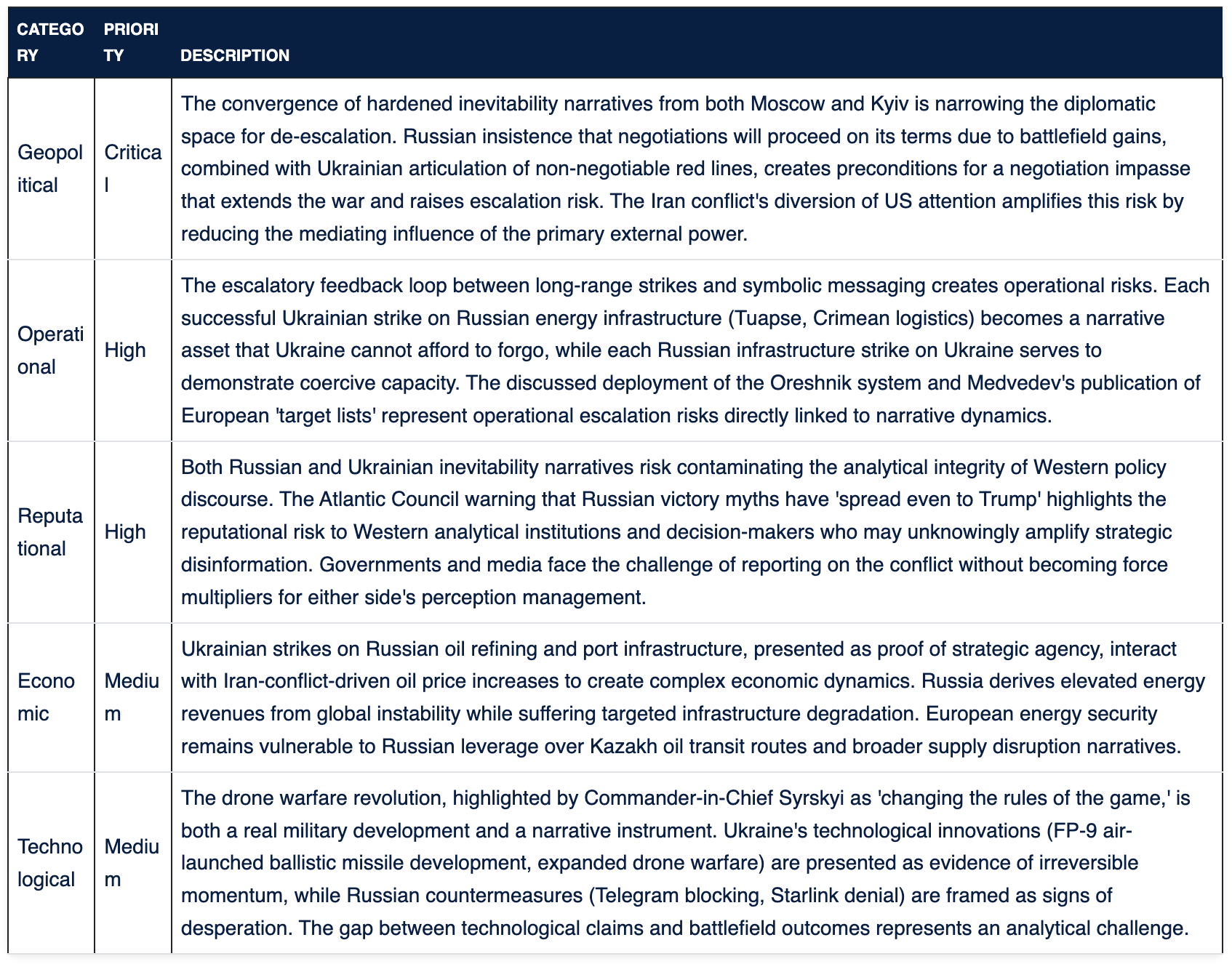
Vulnerability Assessment
The principal vulnerability lies in the information architecture of allied decision-making. Western governments remain susceptible to narrative manipulation from both sides because: (1) battlefield verification is extremely difficult and relies on the same belligerents whose claims require verification; (2) the attention economy creates incentive structures that favour dramatic inevitability claims over nuanced positional analysis; (3) the Iran conflict has degraded the bandwidth available for Ukraine-focused intelligence analysis; (4) domestic political pressures in allied states create receptivity to narratives that simplify complex realities (either ‘Russia is winning, negotiate now’ or ‘Ukraine is winning, increase support’). Additionally, both belligerents face internal vulnerabilities: Russia’s growing gap between external triumphalism and internal anxiety among military bloggers could be exploited but also could generate unpredictable escalatory responses if the narrative facade collapses; Ukraine’s dependence on demonstrating agency to sustain Western support creates pressure for high-visibility strikes that may not always align with optimal military strategy.
Risk Analysis Matrix
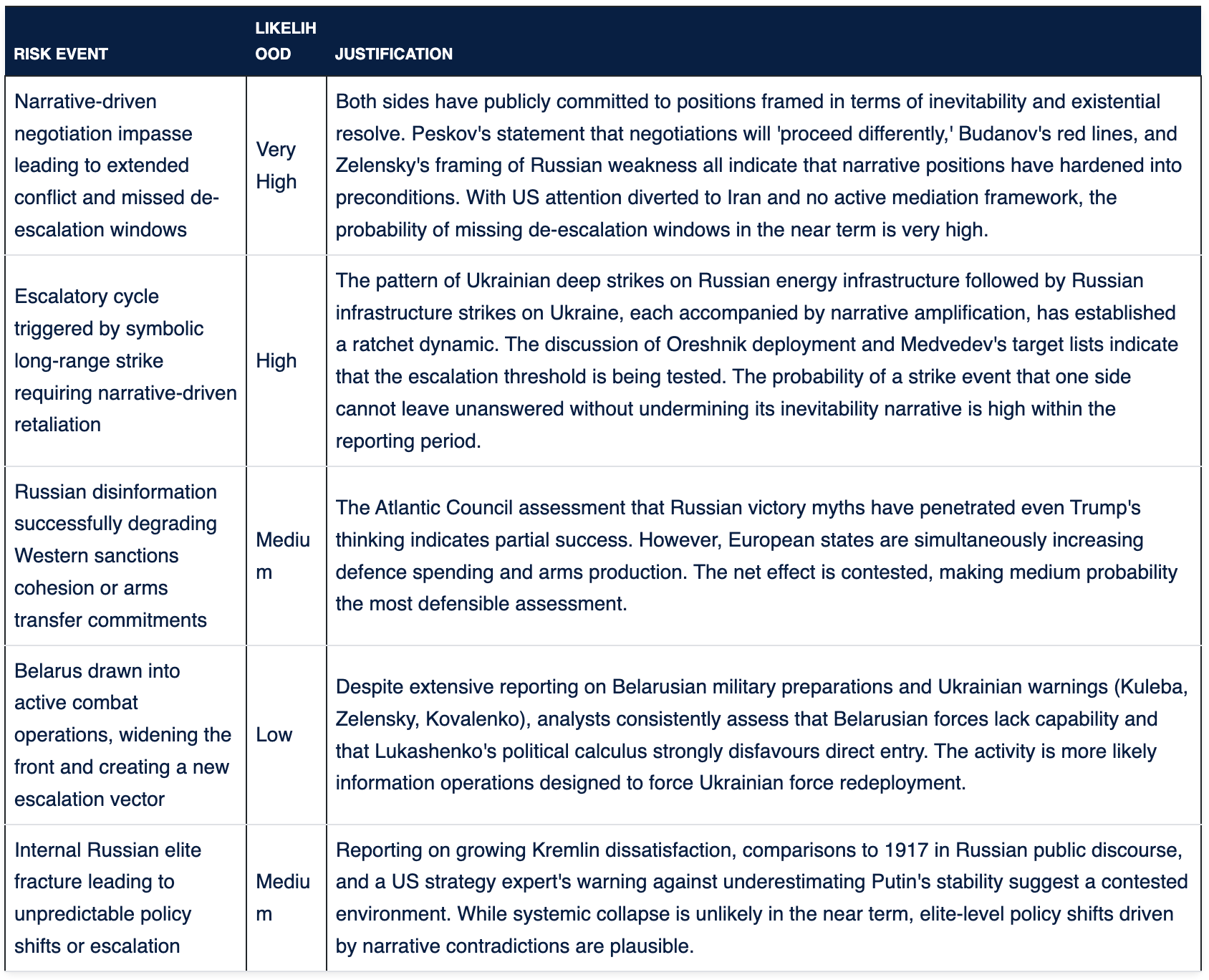
Likelihood Assessment
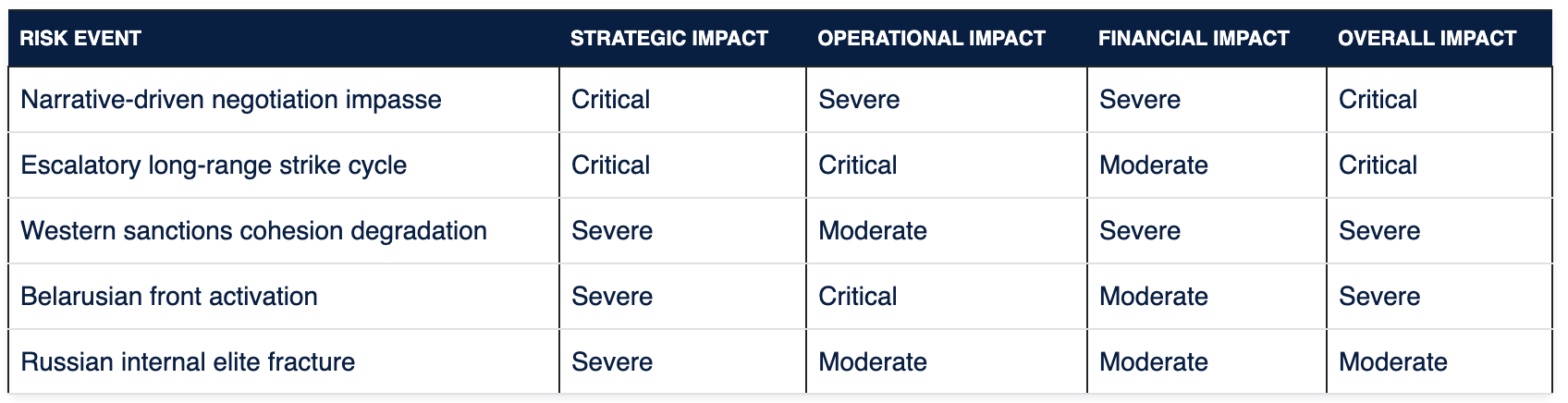
Impact Assessment
Composite Risk Scoring
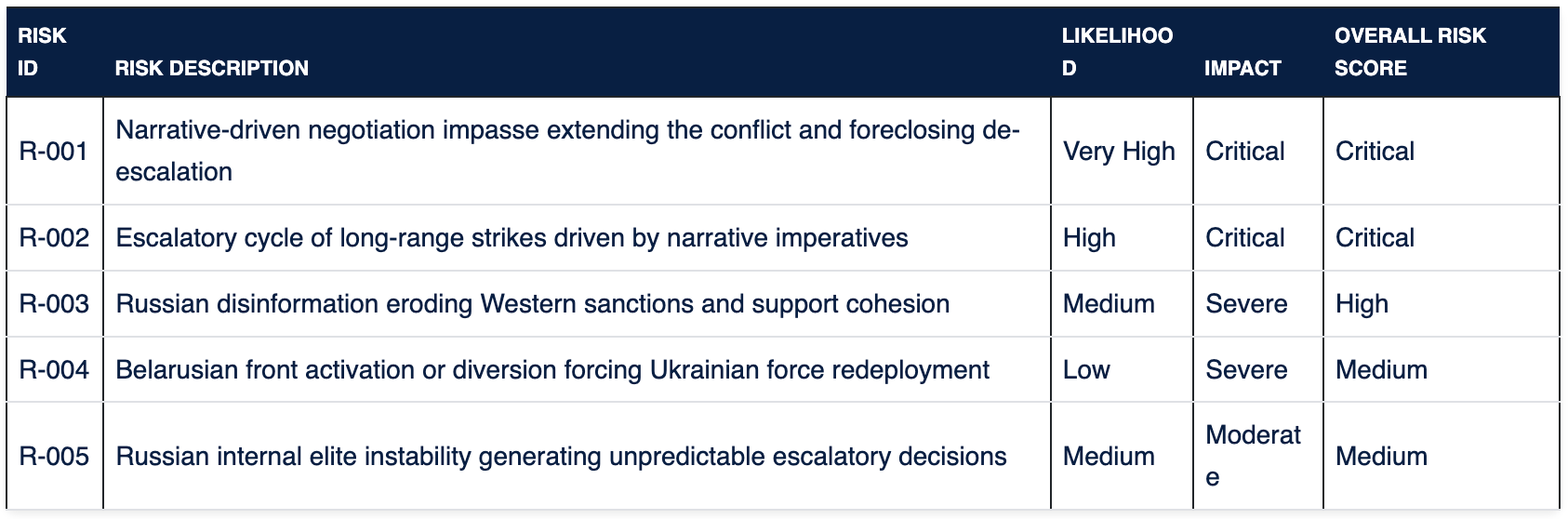
Composite Risk Scoring: Likelihood vs Impact for Identified Risks
GR-001
Risk score (1-5 scale)
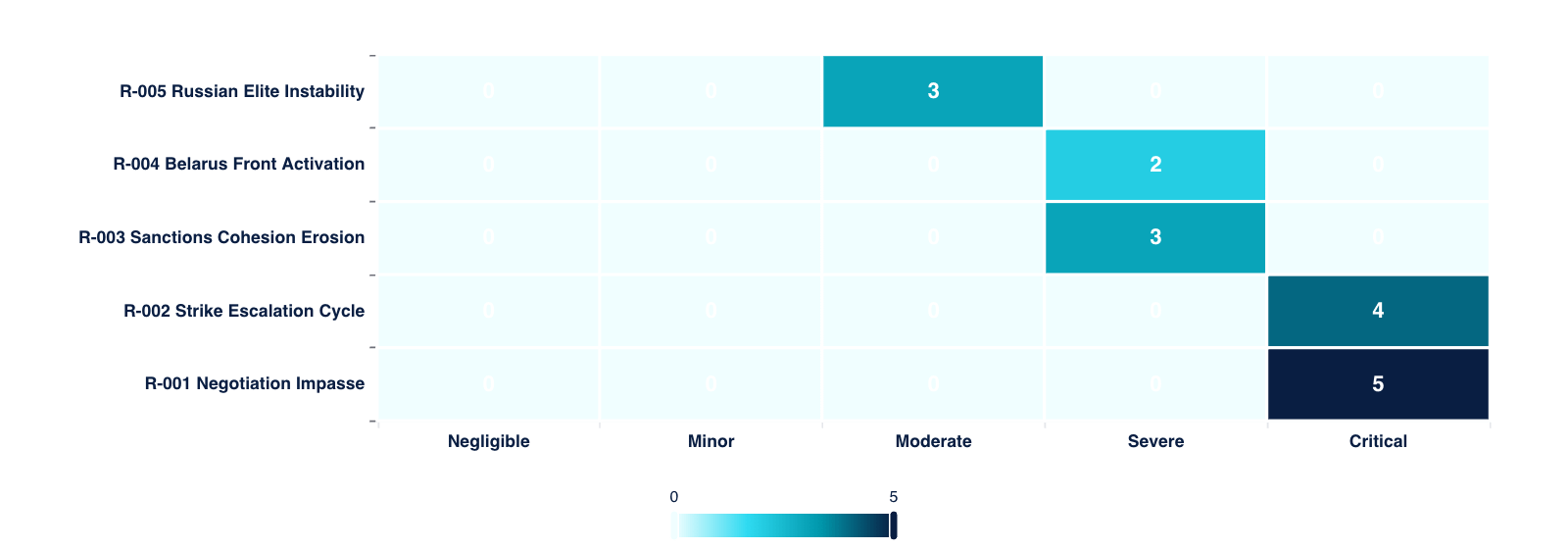
Values represent ordinal likelihood: 5=Very High, 4=High, 3=Medium, 2=Low, 1=Very Low
Position in the column indicates impact level
Insight:The two highest-scoring risks (R-001 and R-002) both involve the direct interaction of narrative operations and kinetic escalation, confirming that the information-kinetic nexus is the primary risk driver.
Likelihood Distribution Across Five Identified Strategic Risks
GR-002
Likelihood (1-5 ordinal scale)
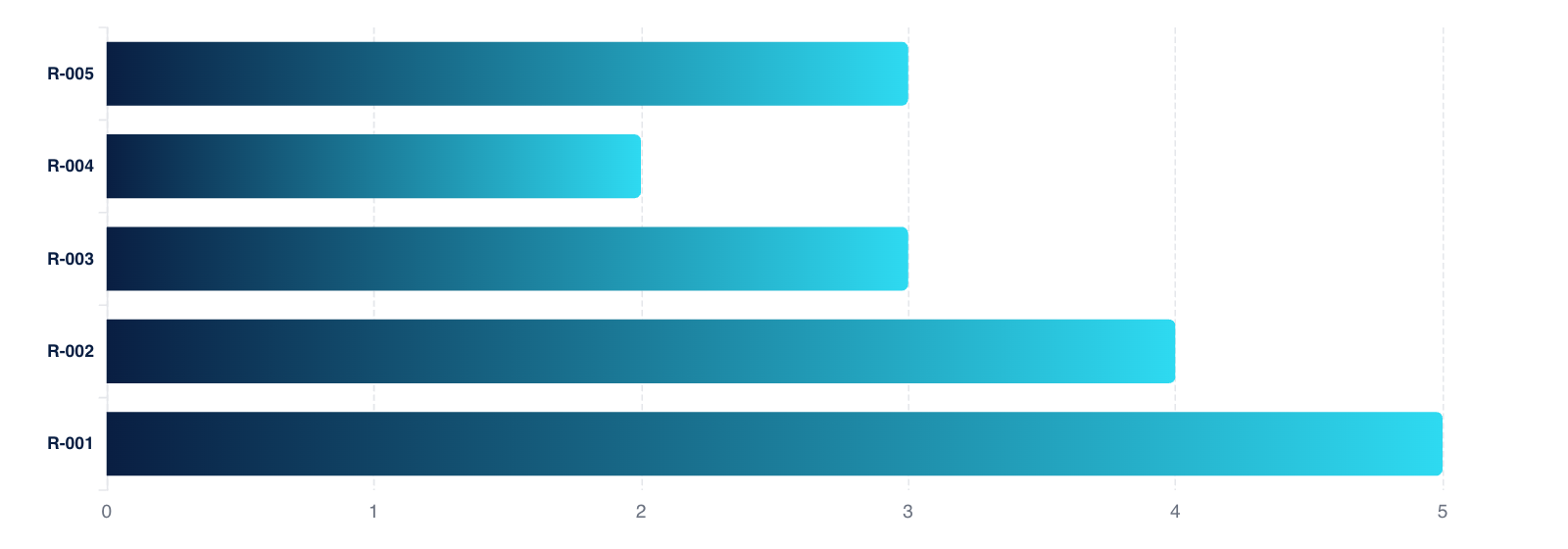
Insight:Narrative-driven risks (R-001, R-002) dominate the high-likelihood band, while kinetic-only risks (R-004) are assessed as less probable, underscoring that information operations are the primary escalation vector.
Detailed Risk Analysis
0
Risk Id
R-001
Risk Title
Narrative-Driven Negotiation Impasse and Foreclosure of De-escalation Windows
Priority Level
Critical
Description
Both Russia and Ukraine have constructed public narrative positions that frame any compromise as capitulation. Russia’s Peskov states negotiations will proceed ‘differently’ due to advances; Lavrov demands ‘security guarantees’ for Russia; Ukraine’s Budanov defines non-negotiable red lines. These positions, once publicly stated in terms of inevitability and resolve, become extremely difficult to walk back without severe domestic political costs. The Iran conflict’s diversion of US mediating capacity further reduces the probability of a diplomatic opening. The risk is that both sides pass through exploitable negotiation windows without acting, extending the war and increasing cumulative escalation risk.
Attack Vectors Risk Pathways
The primary pathway is the feedback loop between public narrative commitment and negotiation flexibility. Each public statement of inevitability raises the domestic political cost of compromise. Secondary pathways include: (1) media amplification of extreme positions by outlets on both sides, which crowds out moderate voices; (2) the attention economy’s incentive to report dramatic claims over nuanced analysis; (3) the instrumentalisation of battlefield events (individual town captures, refinery strikes) as narrative proof-points that anchor negotiating positions to tactical details rather than strategic frameworks.
Confidence Assessment
High
Potential Consequences
Extension of the war beyond 2026 with no active negotiation track, increasing cumulative civilian casualties and infrastructure destruction
Progressive erosion of Western public support for Ukraine as ‘war fatigue’ narratives gain traction in the absence of visible diplomatic progress
Increasing risk that each side makes escalatory decisions to ‘prove’ its inevitability narrative, creating conditions for a major escalatory event
Foreclosure of confidence-building measures (prisoner exchanges, energy infrastructure restraint) that might otherwise create momentum toward broader talks
Time Horizon
Near-term (0-6 months)
1
Risk Id
R-002
Risk Title
Escalatory Feedback Loop Between Long-Range Strikes and Narrative Imperatives
Priority Level
Critical
Description
Ukrainian deep strikes against Russian energy infrastructure (Tuapse refinery, Crimean logistics, ports) and Russian infrastructure strikes on Ukraine are not merely military operations — they are narrative events. Each side requires visible kinetic action to sustain its inevitability narrative. Ukraine needs strikes to demonstrate strategic agency and justify continued Western support; Russia needs strikes to demonstrate coercive capacity and maintain the perception of inevitable Ukrainian collapse. This creates a ratchet dynamic where each successful strike by one side demands a response from the other, not primarily for military reasons but for narrative coherence. The reported discussions of Oreshnik hypersonic deployment and Medvedev’s publication of European ‘target lists’ indicate the escalation threshold is being actively tested.
Attack Vectors Risk Pathways
The escalation pathway proceeds through several stages: (1) a kinetically successful strike by one side generates significant narrative capital; (2) the other side faces pressure to respond with a strike of equal or greater symbolic significance; (3) targeting selection is influenced by narrative impact as much as military utility, potentially leading to strikes on targets with higher escalation risk; (4) each cycle raises the baseline of ‘acceptable’ escalation, normalising progressively more dangerous actions; (5) a single strike on a target perceived as crossing an unstated red line (Moscow-area infrastructure, nuclear-adjacent facilities, NATO-supply routes) could trigger a phase change in the conflict.
Confidence Assessment
High
Potential Consequences
Deployment of advanced Russian weapons systems (Oreshnik) against Ukrainian targets, dramatically raising escalation risk and potentially triggering NATO contingency planning
Ukrainian strikes on progressively deeper Russian targets (ports, pipeline infrastructure) that Russia frames as justifying expanded retaliatory measures against Ukraine or Western states
Normalisation of strikes on energy infrastructure that undermines future prospects for energy-sector confidence-building measures in any negotiation framework
Risk of unintended escalation if a strike results in mass civilian casualties that one side cannot politically absorb without major retaliation
Time Horizon
Immediate
2
Risk Id
R-003
Risk Title
Russian Information Operations Degrading Western Sanctions Cohesion and Allied Unity
Priority Level
High
Description
Russian information operations are achieving measurable strategic effects on Western discourse. The Atlantic Council assessment that Moscow’s ‘inevitable victory’ narrative has reached the Trump administration, combined with Ukraine’s own assessment that SVR chief Naryshkin has convinced Putin to intensify hybrid attacks on EU and NATO, indicates a coordinated campaign to fracture allied cohesion. Russian media projects false impressions about the front-line situation (Latvian analysts specifically note that Moscow creates misleading perceptions of inevitable victory). Simultaneously, Russia targets Gulf states with disinformation to weaken Ukrainian diplomatic gains, as identified by Ukrainian FM Sybiha.
Attack Vectors Risk Pathways
Russia employs a multi-vector approach: (1) diplomatic messaging through Peskov and Lavrov that frames negotiations as proceeding on Russian terms; (2) military-themed disinformation exaggerating battlefield gains and minimising losses; (3) economic narratives leveraging energy price dynamics and sanctions fatigue; (4) hybrid operations against European states (sabotage threats to defence industry leaders per Handelsblatt, cyber operations, political influence) that create domestic pressure to prioritise national security over Ukraine support; (5) exploitation of the Iran conflict distraction to reduce the salience of Ukraine in Western media and policy discourse.
Confidence Assessment
Medium
Potential Consequences
Weakening of EU sanctions enforcement as member states face economic pressure and narrative fatigue
Reduction in arms transfer volumes or delays in delivering critical capabilities as political will erodes
Fragmentation of NATO consensus on Ukraine, with some members seeking bilateral accommodations with Russia
Degradation of intelligence-sharing arrangements as US attention remains focused on Iran
Time Horizon
Near-term (0-6 months)
3
Risk Id
R-004
Risk Title
Belarusian Front Narrative Escalation and Potential Force Diversion
Priority Level
Medium
Description
Extensive reporting throughout April highlights warnings from Ukrainian officials (Zelensky, Kuleba, Kovalenko) about Belarusian military preparations near the Ukrainian border. Analysts consistently assess these as more likely information operations designed to force Ukrainian force redeployment than preparations for actual combat entry. However, the narrative itself has operational effects: Ukraine must maintain defensive forces on the northern border, reducing availability for eastern and southern fronts. The narrative also serves Russia by creating additional uncertainty and expanding the psychological threat surface.
Attack Vectors Risk Pathways
The primary pathway is cognitive rather than kinetic: (1) Russia amplifies indicators of Belarusian military activity to force Ukrainian defensive dispersal; (2) Ukrainian officials amplify the threat to argue for increased Western support and to warn Lukashenko (Zelensky’s ‘Venezuela’ reference); (3) this mutual amplification creates a narrative feedback loop that could generate genuine crisis dynamics even if the underlying military reality does not support them; (4) a misperception or miscalculation during heightened tensions could lead to a border incident that escalates beyond both sides’ intentions.
Confidence Assessment
Medium
Potential Consequences
Forced redeployment of Ukrainian forces from active combat zones to the northern border, weakening eastern and southern defences
Creation of a crisis dynamic that could lead to an inadvertent border incident
Strengthening of Russian leverage in potential negotiations by demonstrating the ability to open a new axis of threat
Absorption of Western analytical and political bandwidth that should be focused on primary conflict dynamics
Time Horizon
Near-term (0-6 months)
4
Risk Id
R-005
Risk Title
Russian Internal Elite Instability Generating Unpredictable Policy Shifts
Priority Level
Medium
Description
Reporting indicates growing dissatisfaction within Russian elites, with charter97 noting deepening splits, comparisons to 1917 appearing in public discourse, and military bloggers increasingly acknowledging the gap between Kremlin rhetoric and battlefield reality. A US strategy expert warns that the West may be underestimating Putin’s political stability, but even Putin allies have publicly warned of crisis. Russian state media allowing discussion of economic difficulties may indicate that factions favouring war termination are gaining influence. Alternatively, this internal dissent could drive more aggressive external action as the Kremlin seeks to rally domestic support through escalation.
Attack Vectors Risk Pathways
Two pathways are possible: (1) A ‘moderation pathway’ where internal pressure leads to genuine interest in negotiations, potentially signalled by shifts in state media rhetoric (already partially observed, with Russian media subtly preparing audiences for ceasefire); (2) An ‘escalation pathway’ where internal pressure leads to external aggression to maintain regime cohesion, potentially including expanded hybrid operations against Europe or more aggressive front-line operations to generate narrative victories. The unpredictability of which pathway dominates is itself a risk.
Confidence Assessment
Low
Potential Consequences
Sudden shift in Russian negotiating posture that Western governments are unprepared for, either toward unexpected concessions or maximalist demands
Internal power struggle that leads to a period of policy incoherence, increasing the risk of miscommunication and miscalculation with Ukraine and the West
Escalatory military action driven by domestic political needs rather than strategic logic, such as a major strike on a symbolic target to rally domestic support
Time Horizon
Medium-term (6-18 months)
Risk Interconnections and Cascading Effects
Risk Dependencies
R-001 (Negotiation Impasse) and R-002 (Strike Escalation Cycle) are mutually reinforcing: the inability to negotiate incentivises both sides to seek narrative advantage through kinetic action, while kinetic escalation hardens positions and further forecloses negotiation. R-003 (Sanctions Cohesion Erosion) depends on R-001 persisting, as prolonged stalemate creates the conditions in which Russian disinformation about inevitable victory gains traction with fatigued Western audiences. R-004 (Belarus Front) serves as a force multiplier for R-001 by expanding the threat surface and complicating any negotiation framework. R-005 (Elite Instability) could either mitigate or amplify all other risks depending on whether it drives moderation or escalation in Russian policy.
Cascading Scenarios
Scenario A (Escalation Cascade): A Ukrainian deep strike on a particularly sensitive Russian target (e.g., a Black Sea port critical to oil exports) generates significant narrative capital for Kyiv but triggers a Russian retaliatory strike using advanced weapons (Oreshnik or equivalent) against a major Ukrainian city. This kinetic escalation (R-002) makes negotiations impossible (R-001), fractures Western unity as some allies seek de-escalation while others advocate stronger response (R-003), and prompts Russian pressure on Belarus to activate the northern front as a diversionary measure (R-004). The compound effect would be a significant expansion of the conflict’s geographic scope and intensity. Scenario B (Narrative Collapse Cascade): Russian internal recognition of battlefield stagnation (R-005) leaks into public discourse faster than state media can manage, creating a gap between the Kremlin’s external inevitability narrative and domestic reality. This undermines Russian negotiating leverage, but rather than opening a diplomatic window, the Kremlin doubles down on escalatory rhetoric and hybrid operations against Europe (R-003) to create external pressure for a settlement on Russian terms. Simultaneously, Ukraine interprets Russian internal weakness as an opportunity to intensify deep strikes (R-002), further destabilising the Russian domestic situation and potentially triggering an unpredictable policy response. Scenario C (Attention Diversion Cascade): The Iran conflict escalates further, drawing US engagement entirely away from Ukraine. Russia exploits this window to launch a significant offensive operation (potentially on the Slavyansk-Kramatorsk axis). The offensive itself may not achieve its objectives, but the narrative of initiative and momentum reinforces the inevitability frame, pressuring European allies to either dramatically increase support or begin seeking a settlement, splitting the alliance (R-003) and foreclosing negotiation on Ukrainian terms (R-001).
Compound Risk Events
The most dangerous compound event would combine elements of all five risks: a long-range strike escalation (R-002) occurring during a period of degraded Western attention due to Iran, when Russian internal pressures (R-005) are driving the Kremlin toward aggressive action, with Belarusian military activity (R-004) adding a second-front dimension. In this scenario, the narrative hardening (R-001) would prevent either side from de-escalating even when the material costs of continued conflict exceed both sides’ prior thresholds. The result would be a conflict that has escalated beyond either side’s original intentions, sustained by narrative positions that neither side can abandon without perceived capitulation.
Risk Interconnection Network: Narrative Operations and Escalation Pathways
GR-003
network
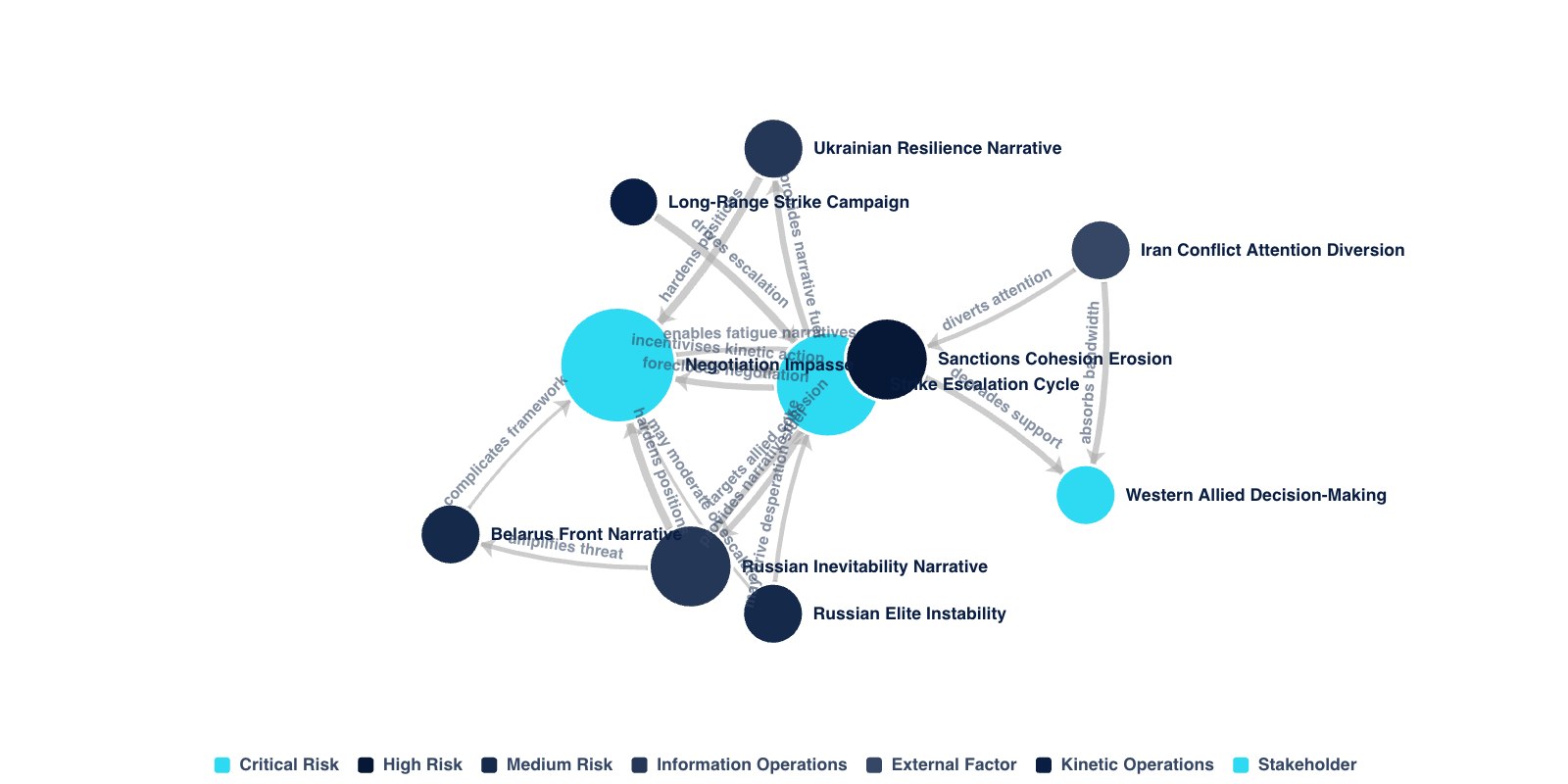
Edge weights represent assessed strength of causal linkage (1-5 scale)
The R-001/R-002 nexus forms the core escalation driver
Insight:R-001 (Negotiation Impasse) and R-002 (Strike Escalation) form a tightly coupled pair at the centre of the risk network, with all other risks feeding into or amplified by this core nexus.
Mitigation Strategies and Recommendations
Priority Mitigation Actions
Risk Id
R-001
Mitigation Strategy
Decouple public narrative positions from negotiating flexibility through quiet diplomacy and managed expectation channels
Recommended Actions
Encourage third-party mediators (Turkey, Gulf states, India) to maintain back-channel contacts with both Moscow and Kyiv that operate independently of public inevitability framing, focusing on concrete confidence-building measures rather than comprehensive settlement
Develop allied messaging frameworks that acknowledge the difficulty of the situation without adopting either side’s inevitability narrative, emphasising process-oriented language (e.g., ‘steps toward security’) rather than outcome-oriented language (’victory’ or ‘defeat’)
Invest in domestic political cover for eventual compromise by preparing allied publics for the complexity of any settlement, including the acknowledgment that neither side will achieve all stated objectives
Maintain regular high-level allied consultations specifically on Ukraine to prevent the Iran conflict from fully displacing Ukraine from the diplomatic agenda
Priority
Critical
Risk Id
R-002
Mitigation Strategy
Establish tacit or explicit norms for strike restraint on escalation-sensitive target categories while maintaining deterrent capability
Recommended Actions
Engage in private communication with both sides to signal that strikes on nuclear-adjacent infrastructure, civilian population centres, or targets with NATO-supply implications would be viewed as crossing a threshold requiring proportional response
Support Ukrainian deep-strike capability as a deterrent while advising on target selection that maximises military utility and minimises escalation risk, focusing on military logistics rather than symbolic targets
Monitor Oreshnik deployment indicators and prepare allied contingency responses to prevent the first use of intermediate-range weapons from triggering an uncontrolled escalation spiral
Develop a pre-agreed allied communication framework for responding to major escalatory strikes by either side, preventing ad hoc responses that could be exploited narratively
Priority
Critical
Risk Id
R-003
Mitigation Strategy
Strengthen analytical resilience against Russian disinformation while maintaining fact-based assessment of Ukrainian claims
Recommended Actions
Fund and expand independent battlefield monitoring capabilities (satellite imagery analysis, open-source intelligence) that can verify or refute claims by both sides without relying on belligerent reporting
Establish regular ‘narrative threat briefings’ for allied political leaders that explicitly identify active Russian and Ukrainian information operations and their intended effects on policy decisions
Invest in counter-disinformation capabilities specifically targeted at Russian narratives in the Gulf states and Global South, where Ukrainian diplomatic gains are most vulnerable
Develop sanctions monitoring mechanisms that track enforcement effectiveness in real-time, providing objective data to counter Russian narratives of sanctions futility
Priority
High
Risk Id
R-004
Mitigation Strategy
Maintain calibrated deterrence on the Belarus axis while avoiding narrative amplification that serves Russian diversion objectives
Recommended Actions
Continue intelligence sharing with Ukraine on Belarusian military movements while assessing these movements against objective indicators of actual combat preparation rather than relying on narrative-driven assessments from either side
Maintain NATO presence and readiness in the Baltic-Polish corridor as a deterrent without escalatory rhetoric that feeds into Russian framing of inevitable NATO-Russia confrontation
Priority
Medium
Risk Id
R-005
Mitigation Strategy
Prepare allied contingency plans for both moderation and escalation pathways in Russian internal dynamics
Recommended Actions
Develop policy frameworks for responding to a potential sudden Russian shift toward negotiations, including pre-agreed allied positions on key issues (territorial arrangements, security guarantees, sanctions relief sequences) to prevent being caught unprepared by a diplomatic opening
Simultaneously prepare for the escalation pathway by ensuring allied deterrence posture is robust against potential Russian aggression driven by domestic political needs, including enhanced NATO readiness on the eastern flank
Priority
Medium
Risk Monitoring Framework
Continuous monitoring should track the following indicators across four domains: (1) Narrative domain: weekly content analysis of Russian state media, Ukrainian official communications, and Western media coverage, tracking the frequency and intensity of inevitability language, shifts in framing (from victory to stalemate or vice versa), and emergence of negotiation-compatible language; (2) Kinetic domain: daily monitoring of strike patterns (target selection, weapon systems used, geographic expansion), with particular attention to strikes on novel target categories or using previously undeployed weapon systems; (3) Diplomatic domain: tracking of all official and unofficial contacts between belligerents and with potential mediators, including changes in stated preconditions for negotiations; (4) Internal stability domain: monitoring of Russian military blogger discourse, economic indicators, mobilisation data, and elite rhetoric for signs of narrative collapse or hardening.
Contingency Planning Requirements
Three contingency plans should be maintained in active readiness: (A) Escalation Response Plan — a pre-agreed allied protocol for responding to the use of intermediate-range weapons (Oreshnik) or strikes on previously untargeted categories, including graduated response options and unified communications strategy; (B) Negotiation Window Exploitation Plan — a prepared framework for rapidly engaging a diplomatic opening if one emerges, including pre-agreed positions on key issues, to prevent negotiation windows from closing before allied consensus can be achieved; (C) Attention Diversion Management Plan — a protocol for maintaining Ukraine policy bandwidth during periods of competing crises (Iran, other), including dedicated staffing, ring-fenced intelligence resources, and regular senior-level reviews.
Resource Requirements
Key resource requirements include: (1) expanded independent battlefield monitoring through commercial satellite imagery and OSINT analysis teams; (2) dedicated information operations analysis capacity focused on the Russia-Ukraine narrative environment, staffed with multilingual analysts covering Russian, Ukrainian, Turkish, Arabic, and European languages; (3) diplomatic resources for maintaining back-channel contacts with both belligerents and potential mediators; (4) strategic communications capacity for developing and disseminating allied messaging that avoids amplifying either side’s inevitability narrative; (5) intelligence resources specifically assigned to monitoring the Belarus axis and Russian internal stability indicators.
Outlook and Early Warning Indicators
Risk Trajectory Assessment
The overall risk trajectory is upward through the summer of 2026. The convergence of narrative hardening, kinetic escalation dynamics, and reduced US mediating capacity creates conditions for a significant escalatory event within the next 3-6 months. The most probable scenario is continued gradual escalation in strike tempo and target ambition, accompanied by progressively more rigid public positions on both sides, resulting in missed opportunities for de-escalation. The less probable but higher-impact scenario involves a single dramatic escalatory event (Oreshnik use, major infrastructure attack, border incident) that triggers a phase change in the conflict. The trajectory could be moderated by: resumption of US engagement with the Ukraine file after Iran stabilisation; a clear Russian recognition (possibly driven by internal pressure) that current offensive capacity is insufficient; or a Ukrainian demonstration of strategic restraint that creates space for diplomatic manoeuvre without undermining deterrence. However, current indicators suggest none of these moderating factors is likely to materialise in the immediate term.
Early Warning Indicators
Shift in Russian state media from triumphalist to compromise-oriented framing (e.g., narrative preparation for ceasefire, emphasis on ‘security guarantees’ rather than territorial maximalism) — would signal potential moderation of R-001 and R-005
Deployment of Oreshnik or equivalent intermediate-range systems to forward positions, or public Russian statements explicitly threatening their use against specific Ukrainian targets — would signal imminent materialisation of R-002
Measurable decline in European arms transfer commitments or sanctions enforcement (tracked through delivery schedules, sanctions violation reporting, or political statements signalling fatigue) — would signal materialisation of R-003
Belarusian military units moving from training areas to forward deployment positions near the Ukrainian border, combined with logistics infrastructure preparation exceeding normal exercise patterns — would signal potential materialisation of R-004
Emergence of public dissent from within Putin’s inner circle (not just military bloggers but cabinet-level or security-council-level figures) — would signal potential phase change in R-005
Trigger Events
A Ukrainian strike that successfully disrupts a critical Russian oil export terminal (Novorossiysk or equivalent), generating a narrative crisis that Russia cannot absorb without major retaliation
A Russian strike using a novel weapon system (Oreshnik) or targeting a previously untargeted category (Western Ukraine logistics hub, government building in Kyiv), representing a deliberate escalation designed to demonstrate the credibility of the inevitability narrative
A US policy decision to formally reduce intelligence sharing with Ukraine or condition further arms transfers on negotiation, signalling that Russian inevitability narratives have achieved their intended effect on Washington decision-making
A border incident on the Belarus-Ukraine line involving direct fire, whether accidental or deliberate, that activates the northern front narrative into a kinetic reality
Assessed Escalation Risk Trajectory: April–October 2026
GR-004
Assessed level (1-10 scale)
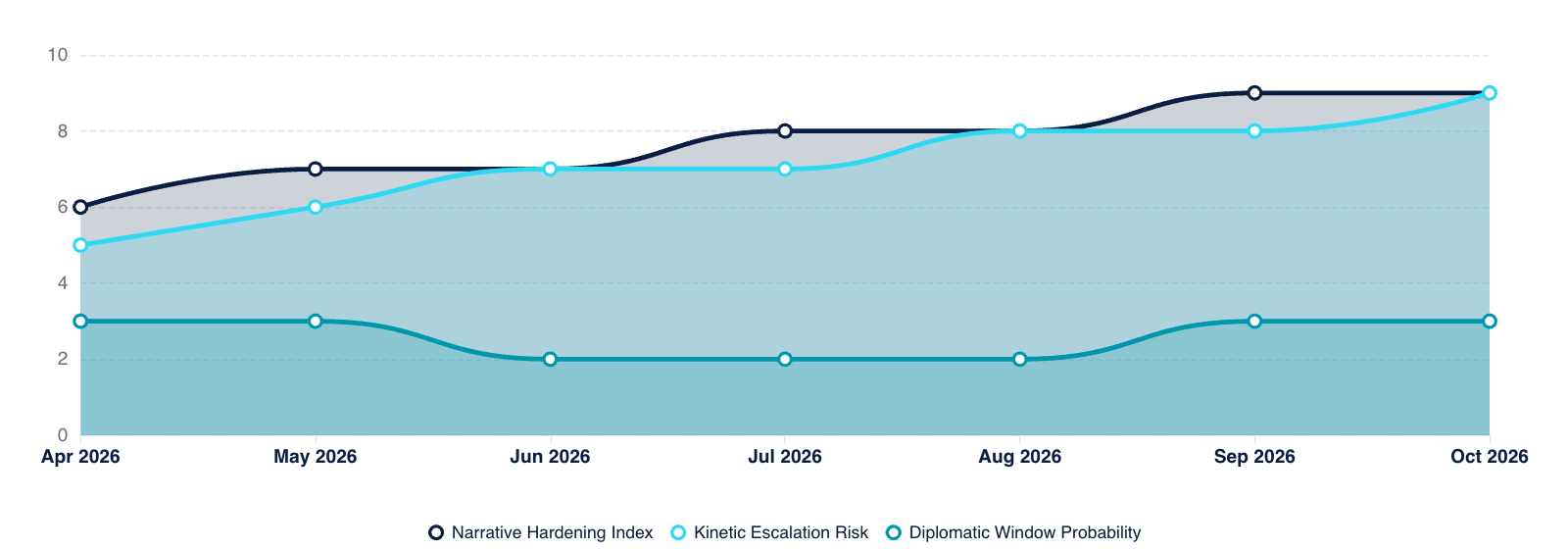
Based on current trajectory; subject to revision if US re-engages or Iran conflict de-escalates
Diplomatic window probability could spike if Russian internal pressures accelerate
Insight:Escalation risk is projected to increase steadily through summer 2026, peaking in September-October when Russian offensive capacity meets narrative pressure for demonstrable results before winter.
Early Warning Indicator Activation Status (April 2026)
GR-005
Activation level (1-5)
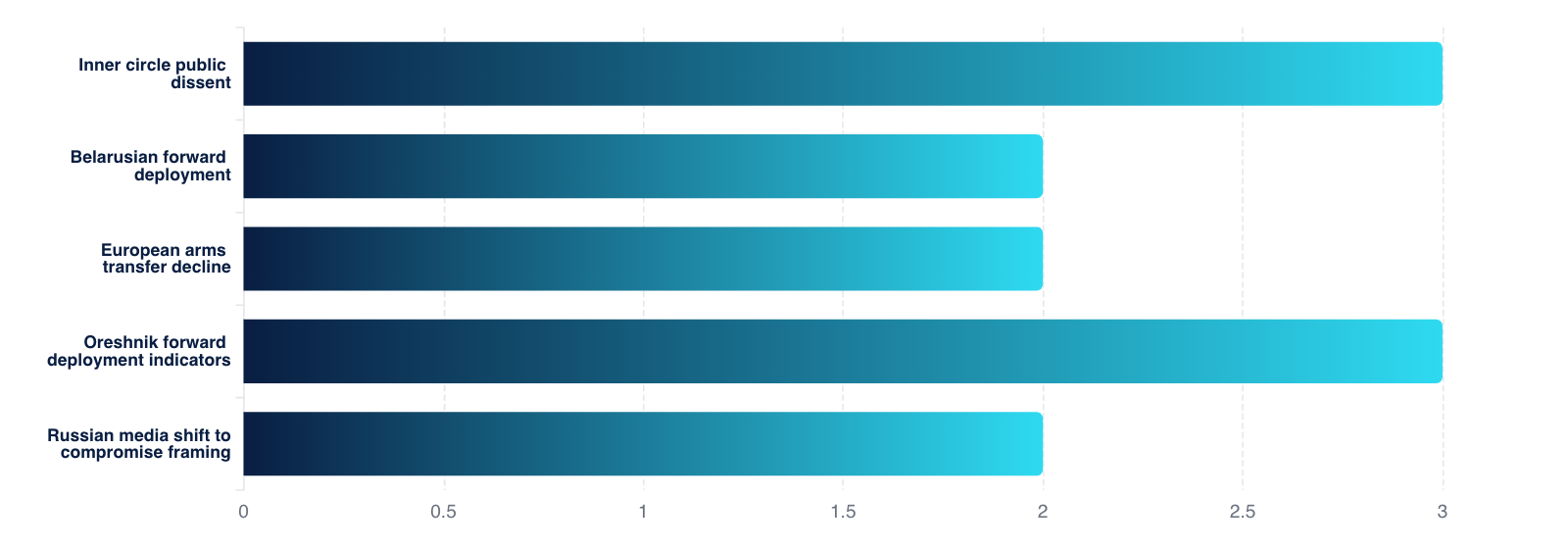
Values derived from indicator frequency in April 2026 reporting
Level 3 = partial activation with multiple corroborating sources
Insight:Narrative indicators are the most activated, confirming that information operations are currently driving escalation risk more than kinetic developments alone.
Confidence Assessment and Intelligence Gaps
Analytic Confidence Levels
Overall analytic confidence is assessed as MODERATE. Confidence in the characterisation of narrative dynamics is HIGH, as this is directly observable through extensive multilingual open-source monitoring covering 17+ languages and corroborated across independent sources. Confidence in the assessment of kinetic escalation risks is MODERATE, as it relies on reported capabilities and stated intentions rather than direct observation of deployment decisions. Confidence in the assessment of Russian internal dynamics is LOW-TO-MODERATE, as reporting on Kremlin decision-making is inherently limited and subject to deliberate manipulation. Confidence in assessments of Western allied cohesion effects is MODERATE, relying on observable policy statements and think-tank analyses (Atlantic Council, Carnegie) rather than classified diplomatic reporting.
Key Assumptions
Both Russia and Ukraine are operating information campaigns with strategic intent, not merely reacting to events — this assumption is strongly supported by the consistency, coordination, and audience-targeting of messaging from both sides, but could be challenged if observed messaging patterns reflect genuine internal chaos rather than coordinated strategy
Western allied decision-making is significantly influenced by the narrative environment surrounding the conflict, and not solely by classified intelligence and diplomatic reporting — this assumption is supported by the Atlantic Council assessment and by observable policy shifts, but the degree of influence is difficult to quantify
The Iran conflict will continue to divert US attention and resources from Ukraine for at least the next 3-6 months — this assumption is based on current reporting and the likely duration of active operations, but could be invalidated by a rapid resolution or escalation of the Iran situation
Russian mobilisation constraints (estimated 80,000 per month requirement for continued advance) are real and not a Ukrainian information operation — this estimate is attributed to Ukrainian military expert Kovalenko and partially corroborated by ISW assessments of slowing advance rates, but independent verification is not available
The gap between Russian external triumphalism and internal anxiety is genuine rather than a deliberate ‘good cop / bad cop’ strategy — this assumption is supported by the apparent inability of Russian state media to fully suppress pessimistic commentary, but deceptive signalling cannot be ruled out
Intelligence Gaps
Kremlin decision-making processes: the extent to which Putin’s inner circle genuinely debates war termination options versus maintains a unified escalatory posture is not observable through open sources and represents the most significant gap in this assessment
Actual Russian mobilisation figures and sustainability thresholds: while estimates exist (Kovalenko’s 80,000/month), independently verifiable data on Russian military manpower replacement rates, casualty figures, and mobilisation capacity is unavailable
The degree to which Western political leaders’ private assessments of the conflict differ from their public positions — the gap between public rhetoric and private calculation is critical for assessing whether Russian information operations are achieving their intended effect but is not accessible through open-source analysis
Targeting decision-making processes in both Ukrainian and Russian military commands: the degree to which target selection is driven by narrative considerations versus military utility is analytically inferred but not directly observed
The actual state of Russian advanced weapons inventories (Oreshnik, Kinzhal, etc.) and the decision thresholds for their use — public discussions of deployment may be deterrence signalling rather than indicators of imminent use, but this distinction cannot be resolved through open sources
Alternative Analyses Considered
Three alternative interpretations were considered: (1) ‘Narrative as noise’ — the possibility that information operations are essentially irrelevant to the strategic dynamics of the conflict, which is driven entirely by material factors (manpower, ammunition, economics). This was rejected because observable policy responses (Trump administration receptivity to Russian framing, European arms transfer debates) demonstrate measurable narrative effects on material outcomes. (2) ‘Russian narrative dominance’ — the possibility that Russia is comprehensively winning the information war and that Ukrainian counter-narratives are failing. This was rejected because Ukrainian deep-strike narratives are demonstrably influencing European support decisions and Russian internal discourse, indicating a contested rather than dominated information environment. (3) ‘Imminent negotiation’ — the possibility that narrative hardening on both sides is a prelude to negotiations rather than a barrier, with each side maximising its stated position before inevitable compromise. This alternative cannot be ruled out and receives LOW-TO-MODERATE confidence. The key distinguishing indicator would be the emergence of back-channel activity and compromise-compatible language beneath the public inevitability framing.
Conclusion
The Russia-Ukraine conflict in April 2026 is increasingly shaped by competing information operations that use ‘inevitability’ framing to harden positions, influence external audiences, and set the terms of any future negotiation. This report identifies five interconnected risks stemming from this dynamic, with the narrative-driven negotiation impasse (R-001) and the escalatory feedback loop between long-range strikes and narrative imperatives (R-002) representing the highest-priority concerns. For governments and analysts, the central challenge is evaluating claims of irreversible momentum from both sides without becoming force multipliers for strategic manipulation. The key analytical discipline is to distinguish between material indicators (rate of advance, casualty ratios, mobilisation sustainability, economic indicators) and narrative indicators (leadership rhetoric, media framing, diplomatic positioning). When narrative positions harden while material indicators stagnate or deteriorate for the claiming party, analysts should assess with high confidence that the narrative represents an information operation rather than a reflection of strategic reality. This distinction is currently most relevant to Russian claims: the Kremlin’s external inevitability narrative is contradicted by ISW-documented halving of advance rates, growing internal Russian anxiety, and mobilisation sustainability challenges. However, Ukrainian narratives also require critical evaluation. Claims of being in the ‘strongest position in ten months’ must be assessed against continued Russian territorial pressure and unresolved mobilisation challenges on the Ukrainian side. Realistic diplomatic mechanisms remain limited but not impossible. The most promising approach involves quiet third-party mediation that operates beneath the public narrative layer, combined with tacit confidence-building measures (energy infrastructure strike restraint, prisoner exchanges, humanitarian corridors) that can reduce escalation risk without requiring either side to publicly retreat from stated positions. The critical enabling condition is re-engagement by the United States once the Iran situation allows, combined with European willingness to maintain independent diplomatic channels. The overall risk trajectory is upward through the summer of 2026. The convergence of narrative hardening, kinetic escalation, US distraction, and Russian internal pressures creates the most dangerous combination of factors since the early phase of the full-scale invasion. Proactive mitigation — particularly in the domains of independent monitoring, counter-disinformation, and quiet diplomacy — is urgently required to prevent narrative lock-in from foreclosing the remaining avenues for de-escalation.
References
Буданов пояснив, чому росіяни не скаржаться на діпстрайки ЗСУ
Три сценарії війни в Україні: що планує Кремль і чи можливий мир
Олег Жданов. Действительно ли Путин нападет на Европу уже в этом году?
Запорізька область стала пріоритетом Росії на півдні - який напрям ворог готує для нового тиску
URL: https://24tv.ua/zaporizka-oblast-stala-prioritetom-rosiyi-pivdni-yakiy-napryam_n3047253
Очікування й реальність: росіяни “захопили в кредит” село на Харківщині
Отчет минобороны РФ об “СВО” в Украине. 1509-й день войны - NEWSru.co.il
URL: https://www.newsru.co.il/world/12apr2026/min_ru_120.html
Розвал Росії - які процеси Україна запустила всередині Росії
URL: https://24tv.ua/rozval-rosiyi-yaki-protsesi-ukrayina-zapustila-vseredini-rosiyi_n3056057
РФ создает угрозу со стороны Беларуси: эксперт оценил риски повторного наступления на Киев
Ukraina opracowała broń-marzenie. Co wyjątkowego tkwi w nowym FP-9?
URL: https://www.chip.pl/2026/04/ukraina-balistyczny-pocisk-powietrze-albm-fp-9
“Нефтебаксы” Путину уже не светят: озвучено интригующее заявление о фиаско диктаторпа
Новый этап информационной войны: что происходит в эфирах России
“Терпение кончилось”. Почему молчание Путина опаснее, чем слова о “красных линиях”
Expertin warnt: Der Westen unterschätzt Putins politische Stabilität
Трамп подав Путіну довгоочікуваний рятівний круг. Що далі
Rusia ka frikë nga rusët: Frika e vërtetë e Putinit nuk është NATO - është demobilizimi
Политолог Кот: Украина вошла в состояние агонии
URL: https://aif.ru/politics/politolog-kot-ukraina-voshla-v-sostoyanie-agonii
О “переломе на фронте” и получении Украиной “стратегической инициативы” (КАРТА)
URL: https://rusvesna.su/news/1777314814
В ультиматум Путина о Донбассе не верят даже в России: СМИ объяснили причину
Castel: A háború nem ér véget, csak átalakul + videó
“Мы точно готовы”: у Зеленского дали громкий прогноз, сколько Путин еще будет воевать
ISW: Украйна продължава да укрепва позициите си срещу Русия
В войне Украины с Россией наметился “перелом”: в ISW указали на изменения на фронте. Карта
Украине придется искать новые подходы: Виктор Андрусов о мобилизации
Україна нищівними ударами по нафті змінює хід переговорів з росією
Катастрофа РФ у війні проти України вже очевидна: ця правда пропаганди Кремля доб’є Путіна
Foreign Affairs: Набліжаецца наступная вайна Еўропы
URL: https://charter97.org/be/news/2026/4/5/679520/
Чем ответит Россия? Запад больше не скрывает свои настоящие планы
Мифы Москвы о ее “неизбежной победе” распространились даже на Трампа, - Atlantic Council
Russia Ukraine War: US Steps Back, Europe Arms Ukraine
URL: https://easternherald.com/2026/04/15/russia-ukraine-war-us-europe-arms/
Песков: Киев понимает, что переговоры пойдут иначе из-за успехов ВС РФ - Новости на Вести.ru
URL: https://www.vesti.ru/ns/peskov-kiev-ponimaet-chto-peregovory-pojdut-inache-iz-za-uspekhov-vs-rf
(Не) ідеальний шторм Кремля. Чому Росія “посипалася”
URL: https://www.real.gr/real_editors_akis_kosonas/arthro/diarkeia-polemon-812847/
Сибіга: Російські фейки - це визнання Москвою успіху України в країнах Затоки
Sõja ülevaade: 1505. päev - Ukraina oli rindel edukam - Lõunaeestlane
URL: https://lounaeestlane.ee/soja-ulevaade-1505-paev-ukraina-oli-rindel-edukam/
Російські порти стали вразливою точкою Кремля - що може стати серйозним ризиком для Путіна
URL: https://24tv.ua/rosiyski-porti-stali-vrazlivoyu-tochkoyu-kremlya-shho-mozhe-stati_n3044290
Чи нападе Росія на країни НАТО - в ОП розповіли, яку інформацію має розвідка
URL: https://24tv.ua/napade-rosiya-krayini-nato-op-rozpovili-yaku-informatsiyu-maye_n3044903
Avertisment din Ucraina. Rusia ar putea lovi UE și NATO prin operațiuni hibride
Чому українці в Європі інакше сприймають загрозу з боку Росії: соціолог назвав причину
Russland-Drohungen: “Gefährdet sind Führungskräfte der Rüstungsindustrie”
Зеленський повідомив про зміну планів РФ у війні
URL: https://ua.korrespondent.net/ukraine/4872779-zelenskyi-povidomyv-pro-zminu-planiv-rf-u-viini
Holdt skjult lenge: Nå avsløres Putins hemmelighet
URL: https://www.dagens.no/nyheter/holdt-skjult-lenge-na-avslores-putins-hemmelighet
أوروبا عجوز بالفعل.. وأوكرانيا عصا استنادها الأخيرة
URL: https://kassioun.org/world-news/item/85961-2026-04-26-18-45-16
Началась ли уже Третья мировая война: эксперт назвал 7 рисков для глобального конфликта
Zelensky: Russia strikes infrastructure due to lack of success on battlefield
Kupjansk pada, ogrožena je pomembna ukrajinska “banana”: na videz
Наступление РФ: россияне угрожают окружить Ореховский узел -- видео
Росія вимагає в України вийти з Донбасу - що кажуть експерти про заяви Пєскова
Чернобыль под прицелом: решится ли Россия на техногенную катастрофу с территории Беларуси
Ukraine-Krieg im Liveticker: +++ 11:47 Munz: Bezahlung russischer Freiwilliger kostet Unsummen +++
URL: https://de.headtopics.com/news/ukraine-krieg-im-liveticker-11-47-munz-bezahlung-81797607
Путіна прикрили, а все інше - ні. Яку проблему російського ППО викрили українські дрони?
URL: https://www.radiosvoboda.org/a/ppo-rosiyi-problemy-urazhennya-ukrayinski-drony/33732095.html
Россия не побеждает и не находится в сильной позиции -- Зеленский: EADaily
Просування ЗСУ -- як успіхи сил України впливають на ситуацію в РФ -- Тимочко
أوكرانيا في مهبّ خلافات ترامب والناتو
“Орешник” ждут и в Киеве, и во Львове. Но куда он прилетит теперь?
URL: https://tsargrad.tv/news/oreshnik-zhdut-i-v-kieve-i-vo-lvove-no-kuda-on-priletit-teper_1637438
URL: https://www.newsru.co.il/world/19apr2026/min_ru_137.html
Буданов пояснив, чому РФ не згадує атаки України- Новини bigmir)net
URL: https://news.bigmir.net/ua/ukraine/10331218-budanov-poyasniv-chomu-rf-ne-zgaduje-ataki-ukrayini
Ці сарве вайна на Блізкім Усходзе “вялікую ўгоду” Лукашэнкі з ЗША? - Салiдарнасць
Russia’s war on Telegram may ignite the very fire it fears - Asia Times
URL: https://asiatimes.com/2026/04/russias-war-on-telegram-may-ignite-the-very-fire-it-fears/
Українські аналітики побачили, як Росія паралізує волю Заходу ще до того, як пролунає перший постріл
Почему Россия не спешит с наступлением на Украине, рассказал Кедми
Навіть Путіна “пройняло”: ISW описав реакцію Кремля на удари України по Туапсе
У ЗСУ розповіли, чи зменшили окупанти інтенсивність наступу
URL: https://zn.ua/ukr/war/u-zsu-rozpovili-chi-zmenshili-okupanti-intensivnist-nastupu-.html
ЦПД предупреждает об “очередной идее старых дедов”: РФ усилит атаки на ЕС и НАТО
URL: https://haqqin.az/newsarchive/381544
У Путіна відкрито заявили про війну з Європою: шокувальна заява Лаврова
URL: https://kontrakty.ua/article/287654
Wladimir Putin: Der Kremlchef ist unter Druck - Expertin warnt vor Zusammenbruch
Эксперт объяснил “венесуэльский” намек Зеленского для Лукашенко
URL: https://www.rbc.ua/ukr/news/ekspert-poyasniv-venesuelskiy-natyak-zelenskogo-1776513465.html
Війна в Україні може затягнутися ще на два роки без прориву в переговорах -- Bloomberg
URL: https://vlasti.net/news/366572
Полковник запаса назвал 3 самых уязвимых места России
URL: https://24tv.ua/ru/polkovnik-zapasa-nazval-3-samyh-ujazvimyh-mesta-rossii_n3047654
Castel: A háború nem ér véget, csak átalakul + videó
URL: https://magyarnemzet.hu/kulfold/2026/04/castel-haboru-nem-er-veget-csak-atalakul-elemzes-front
ომში გაჭედილები - უპირატესობა უკრაინის მხარეს გადადის?
URL: https://www.radiotavisupleba.ge/a/33744449.html
Rusland weegt drie mogelijke oorlogsopties af
URL: https://businessam.be/rusland-weegt-drie-mogelijke-oorlogsopties-af/
Росіяни тиснуть між Покровськом і Добропіллям - як ворог намагається пройти між позиціями
URL: https://24tv.ua/rosiyani-tisnut-mizh-pokrovskom-dobropillyam-yak-vorog-namagayetsya_n3055500
Буданов окреслив “червоні лінії” у переговорах з Росією: на що готова Україна
Оборона Росії стала міфом: розкрито слабкість Кремля, яка доб’є Путіна
Москва поспішає провести наступ до кінця квітня: у чому причина
Ukraine Regroups as War Dynamics Shift: Polish Analyst Analysis - News Directory 3
URL: https://www.newsdirectory3.com/ukraine-regroups-as-war-dynamics-shift-polish-analyst-analysis/
تسلط روسیه بر لوهانسک چه اهمیتی برای مسکو دارد؟
Ягун: Україна -- це не просто фронтир Європи. Це її лабораторія безпеки | Еспресо
URL: https://espreso.tv/poglyad-viyna-v-ukraini-tse-ne-vinyatok-iz-pravil-a-model-maybutnoi-viyni
Enajst novih vojakov po letu dni: Nihče se ne bojuje več, a vsi
Tutkija: Ukraina tuhoaa Venäjän energiainfraa sellaista vauhtia, ettei sitä ehditä korjata
URL: https://www.tivi.fi/uutiset/a/ce17aef9-127b-46a0-bf21-efe9e5927190
Коли зупиниться наступ РФ: експерт прогнозує стагнацію на фронті і сповільнення війни
Крим і логістика окупантів під ударами України - без чого такі атаки не стали б системними
URL: https://24tv.ua/krim-logistika-okupantiv-pid-udarami-ukrayini-bez-chogo-taki_n3046640
Россия не сможет провести наступление в нынешних условиях
URL: https://k-politika.ru/rossiya-ne-smozhet-provesti-nastuplenie-v-nyneshnix-usloviyax/
Удари ЗСУ по тилах РФ підривають здатність ворога вести бойові дії в Україні
URL: https://kontrakty.ua/article/286449
ЦПД попереджає про “чергову ідею старих дідів”: РФ посилить атаки на ЄС та НАТО
URL: https://charter97.org/ru/news/2026/4/23/681531/
Буданов очертил “красные линии” в переговорах с Россией: на что готова Украина
Осенью Путин может начать серию вооруженных конфликтов с НАТО, считает эксперт с Украины
Потрібні мільйони добровольців: The Independent про кризу мобілізації в Україні
Чи може армія Білорусі піти у наступ на Україну? Експерт пояснив важливий момент
“Україна змінює правила гри”: Сирський розповів про інновації на полі бою
Украина научилась воевать без США - The Atlantic
URL: https://prozoro.net.ua/2026/04/20/ukraina-nauchilas-voevat-bez-ssha-the-atlantic/
Конец СВО запустит обратный отсчёт для НАТО: Нидерланды назвали срок до столкновения с Россией
Окончание войны: аналитик спрогнозировал ключевые признаки приближающегося финала
Кремль назвал новое условие для мира в Украине
Гілі: за останні чотири місяці війни в Україні РФ втрачала більше військ ніж мобілізувала
URL: https://lb.ua/world/2026/04/15/732869_gili_ostanni_chotiri_misyatsi.html
России не оставляют выбора. Время заводить “Орешники”. А может и что-то посерьёзнее
Ukraina tuhoaa Venäjän energiainfraa nyt sellaista vauhtia, ettei sitä ehditä korjata, sanoo tutkija
URL: https://www.tekniikkatalous.fi/uutiset/a/272adf68-bda8-48c3-8636-d8023e9567bc
OGNIEM NA WPROST. Przechwycona rozmowa
URL: https://wpolityce.pl/tygodniksieci/757735-ogniem-na-wprost-przechwycona-rozmowa
Ситуація на фронті - військовий оглядач сказав, чого очікувати весною та влітку
URL: https://24tv.ua/situatsiya-fronti-viyskoviy-oglyadach-skazav-chogo-ochikuvati_n3044205
На колькі хопіць беларускага войска для “расейскай мясарубкі” - Салiдарнасць
URL: http://gazetaby.me/post/na-kolki-xopicz-belaruskaga-vojska-dlya-rasejskaj-myasarubki/213733/
Wladimir Solowjow: Brisante Worte im Russen-TV - Putin-Sprachrohr sieht Russland am Ende
Осиновый кол в гроб ЕС и НАТО: эксперт о словах Рютте про вступление Украины
СМИ видят в антироссийской кампании ЕС предвестник крупного столкновения
Отчет минобороны РФ об “СВО” в Украине. 1510-й день войны - NEWSru.co.il
URL: https://www.newsru.co.il/world/13apr2026/min_ru_123.html
“Krizė - neišvengiama”: Rusijos karo tinklaraštininkai pakeitė toną
“Ответные удары”. На Западе испугались решения ЕС против России
“Моральные ограничения сняты”: в Совбезе предупредили о терактах Киева
Sõja ülevaade: 1512. päev - vene poole rünnakute arv tõusis taas kõrgele - Lõunaeestlane
URL: https://lounaeestlane.ee/soja-ulevaade-1512-paev-vene-poole-runnakute-arv-tousis-taas-korgele/
Зеленський заявив про ослаблення тиску США на Росію через Близький Схід- Новини bigmir)net
Ukraina: Siły zbrojne: rosyjska armia stara się rozwinąć ofensywę na północ i zachód od Pokrowska
Песков заявил, что переговоры пойдут иначе из-за успехов ВС России
URL: https://news.mail.ru/politics/70534579/
Наступ ЗС РФ -- темпи просування ворога впали більш ніж удвічі порівняно з минулим роком -- ISW
“Гірше вже не буде”: The New Yorker розкрив, як Зеленський і Путін сприймають війну в Ірані
Сирски: Нема стајања у одлучујућој конфронтацији са Русијом
Россия наносит удары по гражданской инфраструктуре из-за отсутствия успехов на фронте - Зеленский
Zelensky Reminded Lukashenko Of Maduro’s Fate
URL: https://charter97.org/en/news/2026/4/17/680980/
Удари по Москві для України не пріоритет - які цілі зараз дають значно більший результат
Это признают даже ярые пропагандисты: стало очевидно о самой “катастрофе” Путина в Украине.
“Їм страшно” - у РНБО пояснили погрози рф ударами по Європі
Ці сарве вайна на Блізкім Усходзе “вялікую ўгоду” Лукашэнкі з ЗША? - Салiдарнасць
Наступ рф може зірватися? Експерти попередили про сповільнення війни в Україні
Putin Ally Warns of Imminent Moscow Coup - Jason Jay Smart
URL: https://www.democraticunderground.com/113356554
موسكو تهدد برلين بورقة نفط كازاخستان
URL: https://www.alwatan.com.sa/article/1179774
Миршаймер считает, что РФ получит на Украине замороженный конфликт - Новости на Вести.ru
URL: https://www.vesti.ru/ns/mirshajmer-schitaet-chto-rf-poluchit-na-ukraine-zamorozhennyj-konflikt
Экс-глава МИД Украины Кулеба: Лукашенко готовится к войне
URL: https://charter97.org/ru/news/2026/4/20/681182/
DEBATT: Ryssland söker sin nya identitet
URL: https://www.vlt.se/opinion/debatt/ryssland-soker-sin-nya-identitet/
У війні України з Росією намітився “злам”: в ISW вказали на зміни на фронті. Карта
“Трамп будет давить”: тревожный сценарий окончания войны с капитуляцией
Наступление рф может сорваться? Эксперты предупредили о замедлении войны в Украине
URL: https://news.zerkalo.io/world/126176.html
Лукашенко готов вступить в войну?
URL: https://imperialnews.org/56696-lukashenko-gotov-vstupit-v-voynu.html
В ультиматум Путіна щодо Донбасу не вірять навіть у Росії: ЗМІ пояснили причину
من الذي حل محل أمريكا في تزويد أوكرانيا بالمعلومات الاستخبارية؟
LIVE | Trump nodigt Poetin uit voor G20-top, maar betwijfelt dat hij komt
Катастрофа РФ в войне против Украины уже очевидна: эта правда пропаганды Кремля добьет Путина
Путин оказался в тупике в Украине и может пойти войной на Европу: в WP указали на главный риск
Кремль готовит новый фронт: почему возросла вероятность того, что Беларусь могут втянуть в войну
Україна посилює перевагу на фронті, а у Росії вимальовуються довгострокові проблеми - ISW
Znalec srovnává íránskou válku s ukrajinskou. Kde Trump s Putinem udělali chybu?
Миф о “непобедимости” лопнул: эксперты оценили амбиции Кремля на захват Донбасса
1499. dzień wojny. Czy w Ukrainie są “synowie senatora”? Rosja otwiera kolejny front
В РФ пожаловались, что им тяжело “воевать на трех фронтах”
Міфи Москви про її “неминучу перемогу” поширилися навіть на Трампа, - Atlantic Council
Как несколько тысяч дронов могут изменить правила игры в войне: Копытько раскрыл секрет
Пєсков заявив, що мирні переговори тепер ітимуть інакше
Mis on Balti riikide ründamisest rääkivate juttude taga?
URL: https://www.postimees.ee/8457121/mis-on-balti-riikide-rundamisest-raakivate-juttude-taga
Сибіга пояснив причину сплеску російських фейків про країни Затоки
Մոսկվան արձագանքել է Զելենսկու հայտարարությանը․ խոսքը “պրովոկացիայի” մասին է
URL: https://lurer.com/article/728105/am
Auch Deutschland darunter: Erstmals “Liste von Angriffszielen” veröffentlicht - Russland macht ernst
“Нафтобакси” Путіну вже не світять: озвувчено інтригуючу заячву про фіаско диктаторпа
“Такого ніколи не було”: Тимочко пояснив, що зараз відбувається у війні проти Росії
LIVE | Trump nodigt Poetin uit voor G20-top, maar betwijfelt dat hij komt
“Приводів немає”: Зеленський пояснив, чому не можна послаблювати санкції проти РФ
“Это означает признание их слабости”: Буданов объяснил, почему РФ не жалуется на атаки Украины
Russia and Iran’s declining influence reshapes South Caucasus
URL: https://www.azernews.az/analysis/256903.html
Расце незадаволенасць Крамлём паглыбляе раскол у расійскай эліце
URL: https://charter97.org/be/news/2026/4/28/682108/
В Госдуме ответили на заявление Украины о переломе хода конфликта
Ягун про перспективу наступу з боку Білорусі | Еспресо
URL: https://espreso.tv/poglyad-napad-z-bilorusi-u-tsiy-gri-vikhodu-nazad-ne-peredbacheno
Як війна в Ірані допомагає Росії продовжувати агресію: що кажуть в ОП
URL: https://www.rbc.ua/rus/news/k-viyna-irani-dopomagae-rosiyi-prodovzhuvati-1775631219.html
Новий етап інформаційної війни: що відбувається в ефірах рф
WELT: Расія губляе ініцыятыву на фронце
URL: https://charter97.org/be/news/2026/4/17/680975/
Паника в Z-лагере: Прилепин пугает Кремль украинскими ракетами и ударами по Москве
Растущее недовольство Кремлем углубляет раскол в российской элите
URL: https://charter97.org/ru/news/2026/4/28/682108/
Какой ценой РФ продвигается на фронте в апреле: Коваленко раскрыл потери оккупантов
РФ наступає на прикордоння: дрони Британії та війна за тиждень - News Ukraine
URL: https://www.newsukraine.com.ua/rf-nastupaie-na-prykordonnia-drony-brytanii-ta-viina-za-tyzhden/
Castel: A háború nem ér véget, csak átalakul + videó
Пътят към украинската победа - Русия гори, но не метафорично, а буквално - Фактор
URL: https://faktor.bg/patqt-kam-ukrainskata-pobeda-rusiq-gori-no-ne-metaforichno-a-bukvalno
Россияне начали говорить о “катастрофе” в войне против Украины: чего боится пропаганда
Когда остановится наступление РФ: эксперт прогнозирует стагнацию на фронте и замедление войны
Эксперты оценили военную ситуацию на подступах к рубежам Донбасса
URL: https://deita.ru/article/584562
“Украина меняет правила игры”: Сырский рассказал об инновациях на поле боя
Украина усиливает преимущество на фронте, а у России вырисовываются долгосрочные проблемы - ISW